Life
The Ultimate Gaming Experience
About The Book
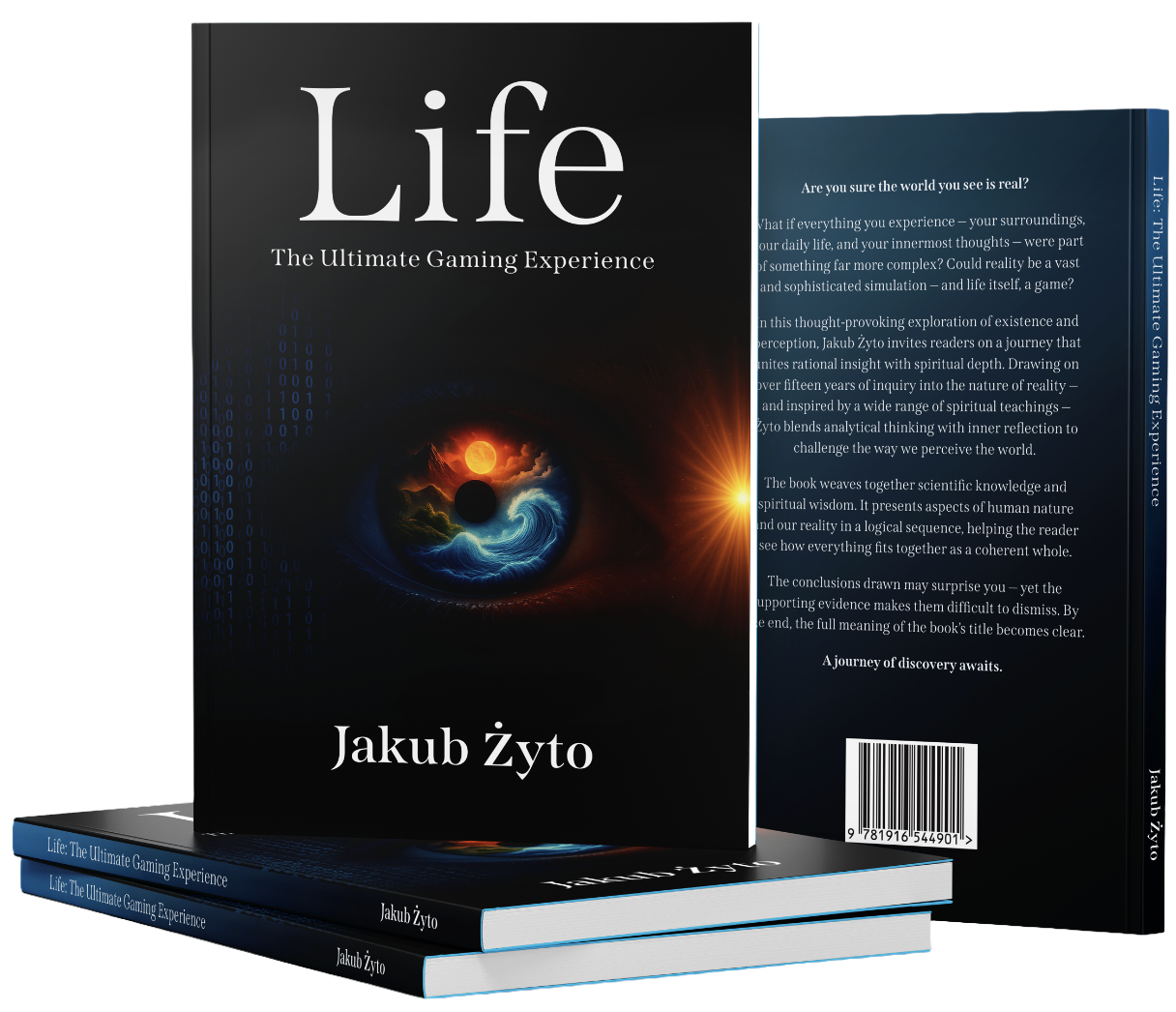
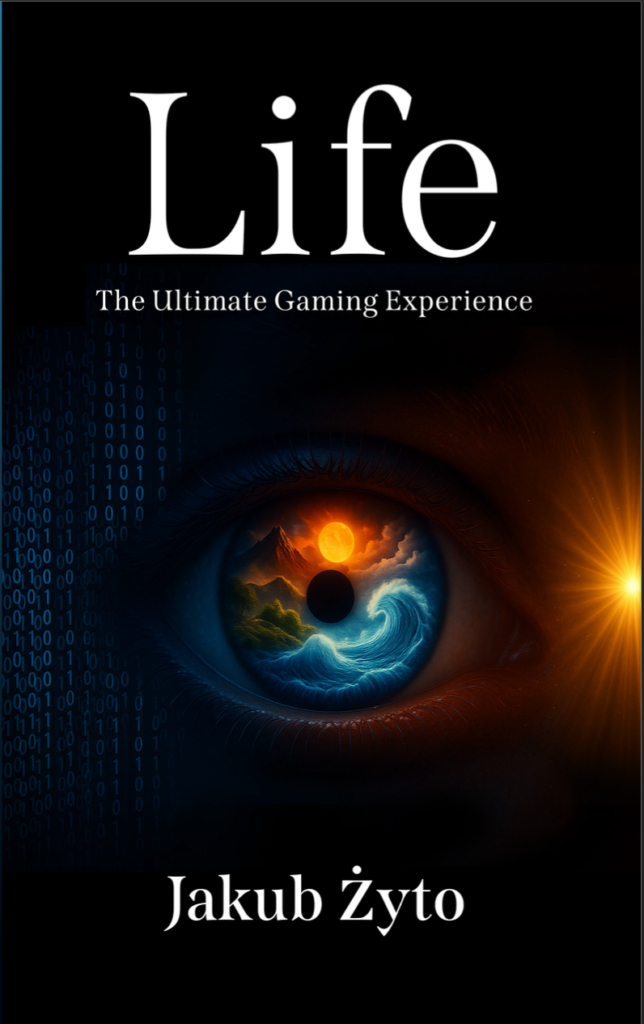
Are you sure the world you see is real? What if everything you experience—your surroundings, daily life, even your innermost thoughts—were part of something far more complex? Could reality be a vast simulation, and life itself, a game?
In Life: The Ultimate Gaming Experience, Jakub Żyto invites readers on a journey that unites rational insight with spiritual depth. Drawing on a wide range of scientific and spiritual perspectives, he blends analytical thinking with inner reflection to challenge the way we perceive the world.
The book weaves together scientific knowledge and spiritual wisdom, presenting aspects of human nature and reality in a logical sequence so readers can see how everything fits together. Its thought-provoking conclusions may surprise you—yet the supporting evidence makes them difficult to dismiss. By the end, the full meaning of the title becomes clear.
Life: The Ultimate Gaming Experience was longlisted for the 2026 CAP Awards in the Non-Fiction category.
The Polish edition of the book, Życie: Najwyższa gra, is now available.
What Readers Say
I’d love to hear your thoughts! Share your feedback or first impressions by emailing me at
info@jakubzyto.com
A Stunning Read
A stunning read! This thought provoking book challenges the typical societal beliefs of the reader and opens an entire other possibility. While diving into complex theories, Jakub keeps the ideas portrayed in the book easy to digest and understand. The book flows perfectly and has amazing original photography to keep it totally unique! Is life a simulation after all?
Oisin
Fascinating and Intellectually Stimulating
Life: The Ultimate Gaming Experience is a fascinating and deeply thought-provoking book that encourages you to question something we often take for granted: what is reality, and how much of what we experience can truly be trusted? … The writing is calm, logical, and reflective, making it an excellent choice for anyone interested in consciousness, spirituality, philosophy, or the nature of reality…
AJ. S
A Taste of Many Ideas
Reading Life: The Ultimate Gaming Experience is like dining on a fantastic tapas meal. The author gives you a flavour of each topic, dwelling on it just long enough to ensure your mental taste buds begin to tingle. From prehistoric advanced technology and religious beliefs to a fascinating examination of our perception of reality… the book presents factual evidence that challenges our assumption that we are the most advanced humans ever to have lived…
Dave Griffin
A Thought-Provoking Exploration
I truly recommend this book; it is great! I enjoyed the way it is written and the ideas it contains. It is a thought-provoking exploration and I think everyone will like it. Highly recommend!
Malgorzata Sekowska
Flows Effortlessly
The book flows effortlessly, keeping you engaged from start to finish. It explores many aspects of human life, including fundamental questions we would all love to understand, and leaves you thinking about it long after you’ve finished reading.
Bartek
Opens Your Eyes
This book opens your eyes to different aspects of life and the world. The author looks at reality from scientific, philosophical, and spiritual perspectives. It does not give ready-made answers, but instead plants a seed of thought and encourages the reader to search for the truth on their own.
Maciej Ludwiczak
More Questions Than Answers
A profound and thought provoking little book that’s easy to digest , which should leave a more open and inquisitive mind with more questions than answers . As Jason Breshears so eloquently put it “ Our world is not what you think and we are more than we suppose ourselves to be “
William
A Book That Stays With You
I just finished reading this book, and I have to say it’s truly brilliant. The facts mentioned from an unusual perspective are gathering in a surprising conclusions and everything ties together to make you reflect. What I loved most is how it keeps making you think long after you’ve turned the last page — it challenges your perspectives in the most engaging way. Highly recommended!
Chiara Fratto
A Perfect Balance
Life: The Ultimate Gaming Experience really surprised me in a good way. It is one of those books that makes me think without trying to tell me what to think. I liked that it sits somewhere between science and spirituality, without becoming too scientific or too religious. … It left space for my own thoughts, questions and interpretations.
Mariusz
Insightful & Lasting
I truly recommend this book (Life: The Ultimate Gaming Experience). It is thought-provoking and offering insight that stays with you long after you finish reading. I enjoyed the ideas and the way they made me think. The book it a great choice for every reader, whether you’re new to the topic or already familiar with it. Highly recommended.
Agnieszka Siekierska
Professional Feedback
Drawing upon subjects as diverse as computer science, psychology, mathematics and archaeology, this thought-provoking book delves into the ways human perception and thoughts can shape reality. A must-read for those who want to explore the topics covered by The Matrix and The Secret.
Dr Tiziana Soverino
Editorial Review
Walking a fine line between science and spirituality, materialism and metaphysics, Jakub Żyto’s provocative and erudite enquiry challenges us to consider whether the very fabric of our reality may not be as it seems and whether, indeed, our future is dependent on the rules of a game.
Dr Sarah Meehan O'Callaghan
Reflections
Short reflections inspired by themes explored in the book Life: The Ultimate Gaming Experience.
Is Reality Written in Code?
Intro:
Let’s look at the structure of our reality and see that it is based on precise principles. Science describes the world and the processes occurring within it using numbers and equations. In other words, it uses the language of mathematics. This raises a deeper question: Can reality operate like computer code?
Reflection:
Every field of science describes the principles of reality through a set of rules. In chemistry, elements combine only in specific ways. In physics, constants describe the fundamental laws of nature and determine its unchanging properties. In this way, reality is governed by a set of rules.
A prime example of structured information in nature is DNA. The molecular sequence of this code contains information that controls the construction of proteins, which are both the basic building blocks of the human body and perform many important functions. DNA specifies where, when, and in what quantities they are created.
This process resembles the logic found in computer programming. Computer programming, at its most fundamental level, is built on simple conditional “if-then” logic: if a certain condition is met, then a specific outcome occurs.
This principle is easy to illustrate with classical physics. Newton’s third law states that every action is accompanied by an equal and opposite reaction. This law operates on the same cause-and-effect principle: if there is an action, then there is a reaction.
Regardless of whether we see the order of this world as a structure or design, or whether it is simply the nature of reality, one thing is certain: the world does not operate randomly. Reality is based on consistent and reliable principles expressed through numbers and relationships.
The World as a System of Cycles
Intro:
Let’s look at the structure of our reality again and see that it is also based on cycles. Nothing moves in straight lines; instead, it unfolds through repeating patterns.
Reflection:
Time, nature and our very existence are composed of cycles. Day follows night. One season follows another. Growth is followed by decline, only to begin again.
These cycles may seem separate; however, they are deeply interconnected and form a kind of system. This system resembles the mechanism of a mechanical clock, where the movement of larger gears sets the smaller ones in motion. Let’s take a closer look at this.
The Sun plays a central role in life on Earth; think of it as one of the larger gears. Its daily presence defines the cycle of light and darkness. At the same time, its changing position in the sky throughout the year influences temperature and daylight length, causing the progression of the seasons. The changing seasons, in turn, set the cycle of nature in motion from spring to winter and back again, regulating life from growth to dormancy. At another level, environmental cycles influence biological cycles, which in turn affect internal processes within the human body.
Each rhythm sets the conditions for another. Like interlocking gears, the motion of one cycle sets another in motion. Reality, therefore, is not linear but shaped by ongoing cycles and repetition.
Energy and Transformation
Intro:
Very little appears to remain unchanged in our world. Although different forms emerge, transform, and eventually disappear, one thing remains constant.
Reflection:
Science describes energy as something that cannot be created or destroyed, but it can only change form. For example, light becomes chemical energy in plants and chemical energy becomes movement in animals. Heat, motion and electricity are all different forms of energy that participate in a continuous process of transformation. These processes are reflected everywhere, within the human body and the natural world.
According to modern physics, matter and energy can be converted into one another. From this perspective, another aspect of the structure of reality is revealed: it can be understood as a continuous expression of energy.
Although forms change, energy remains the fundamental substance of our reality.
Perception and Reality
Intro:
Human perception allows us to interact with the world. We rarely stop to realise that we perceive only a small portion of what may actually exist around us.
Reflection:
Our senses function as biological receivers that detect specific forms of energy. For example, we interpret electromagnetic radiation as visible light with our eyes and convert air vibrations into sound with our ears. What we sense as touch are pressure and temperature translated into tactile sensations by the receptors in the skin.
The range of signals detectable by human senses is limited. For example, the electromagnetic spectrum extends beyond the band of visible light, but we cannot perceive infrared and ultraviolet radiation. Similar limitations apply to hearing. We perceive sound only within the specific range of frequencies, while many animals detect vibrations outside these limits; for instance, bats navigate using ultrasonic signals.
These examples illustrate that our experience of the world is filtered through the capabilities of our sensory system. At the same time, our experience is not restricted to sensory input, as non-sensory perception exists too…
Reality itself may extend far beyond what our senses can detect. Or… perhaps it is not perception that is limited, but reality itself? After all, are light, sound and other forms of energy not just a pure, shapeless form of energy? And do they not only become vision or sound when detected by our sensory organs, such as our eyes or ears? What we perceive as the physical world may only exist through our senses.
The Mind and Its Programming
Intro:
Much of human behaviour appears deliberate and conscious. Yet a closer look at the workings of the mind suggests that many of our actions originate from patterns established long before we begin to question them.
Reflection:
The human mind operates through two closely connected processes: conscious thought and subconscious activity. The conscious mind allows us to analyse situations, make decisions, and reflect on our experiences. The subconscious mind, however, manages an enormous number of processes automatically. Do you actively think while performing routine activities such as driving or carrying out daily tasks? Most likely not. Such activities illustrate how the mind can function efficiently without conscious supervision.
Many of our habits, reactions, and behavioural patterns develop early in life. During childhood, individuals absorb information from their surroundings at an extraordinary rate. Family, culture, education, and social expectations gradually shape our beliefs about what is acceptable, desirable, or true. Over time, these beliefs become ingrained in our subconscious and often guide our behaviour automatically.
Recognising this aspect of the mind invites an important reflection: how much of our behaviour truly originates from deliberate choice, and how much follows patterns learned earlier in life?
Awareness of these patterns provides an opportunity to examine them more carefully. By reflecting on the beliefs and assumptions we hold, we can begin to recognise which of them genuinely align with our own understanding of the world.
Note on Influence
This reflection builds upon the concepts of subconscious programming and behavioral conditioning explored in Bruce Lipton’s The Biology of Belief and Don Miguel Ruiz’s The Four Agreements.
Imagination and Intuition
Intro:
Human perception is not limited to sensory input, as we can also receive non-sensory signals. Two of the most intriguing non-sensory abilities that distinguish humans are imagination and intuition. Both allow us to extend beyond the information our senses provide and explore possibilities that do not yet exist in physical form.
Reflection:
Imagination enables us to form mental images of objects or ideas that are not present in our surroundings. It allows humans to design buildings, compose music and develop ideas that later become scientific discoveries or works of art.
In this sense, imagination is the mother of creativity – it acts as a bridge between thought and creation. Many inventions and artistic works begin with an imagined possibility rather than with direct observation.
Intuition is even more mysterious. It is a form of immediate understanding which does not follow a step-by-step reasoning process. People often describe it as a “gut feeling” or an inner sense that something is right or wrong, even if the logical analysis does not confirm it.
Both imagination and intuition operate in ways we do not fully understand. They do not rely on deliberate analysis, yet they often play a significant role in creativity, decision-making, and discovery.
These abilities suggest that the human mind can do more than just process existing information; it can also explore possibilities beyond what can be sensed.
The Two Aspects of the Self
Intro:
“Who am I?” When we reflect on this question, the answer often seems obvious. I am who I am. We tend to identify ourselves with our thoughts, our background, and the life we’ve experienced so far. This is, however, only partially true… or not true at all.
Reflection:
Our sense of self often derives from the mind – a sense of self commonly called the ego. The mind constantly produces thoughts, opinions, and interpretations about the world and ourselves. These mental processes form what we commonly call our personality or identity. Much of this identity develops through our experiences, upbringing, education, and cultural environment.
However, we often fail to realise that our mind is merely a tool, and the ego may not represent our true identity.
On another, deeper level, a second sense of self appears to exist. At times, we notice our own thinking or become aware of emotions as they arise. Who is the observer? What is the second sense of self? Perhaps it is consciousness itself, which exists beyond name and form.
Many philosophical traditions have reflected on this perspective. The dual sense of self introduces a firm distinction within our experience. Who are you really?
Note on Influence
This reflection builds upon the concepts of presence and awareness from Eckhart Tolle’s The Power of Now.
The Search for Meaning
Intro:
Where do we come from? What are we? Where are we? Where are we going? Since the dawn of time, humanity has been asking these fundamental questions about existence.
Reflection:
People have long wondered about the origin of the universe, the nature of reality, and the purpose of human life. Science approaches these questions through observation and experimentation, and looks for measurable evidence.
At the same time, philosophical and spiritual traditions explore the same questions from a different perspective. They don’t rely solely on external observation, but examine human experience and consciousness.
Both approaches share a common motivation: a desire to understand the nature of existence and the meaning of life. Even as scientific knowledge expands and civilisations advance, the questions remain unanswered.
This enduring search hasn’t yet led to definitive answers. Yet asking these questions remains critical in shaping how we understand both the world and ourselves.
Reality as a Potential Simulation
Intro:
Technological progress makes it possible to create computer simulations, in other words, complex virtual environments. As these simulations become increasingly advanced, a natural question arises: could reality itself function in a way similar to a simulation?
Reflection:
Modern computer simulations allow their creators to recreate environments that imitate aspects of the real world. Events within a simulated environment are subject to strictly programmed rules. These rules determine, among other things, how movement takes place, how objects interact with one another, etc.
As computing power increases, these simulations become increasingly detailed and immersive. It seems that it is no longer a question of ‘whether’, but ‘when’ we will be able to generate environments so realistic that they will be indistinguishable from real ones.
This incredible technological progress has inspired a certain philosophical hypothesis: if a sufficiently advanced civilisation were capable of simulating entire worlds, it would be possible to create an environment so convincing that the people experiencing it would not be able to distinguish it from reality. (1)
But what if the reality we experience every day were subject to rules similar to those found in simulations? Does our world not function according to certain laws of physics and mathematical patterns? Is the extraordinary order and consistency in nature not almost too perfect?
At present, the simulation hypothesis remains a philosophical theory. Unconfirmed, although, by definition, no theory, including a scientific one, can ever be proven with absolute certainty, which is why it remains a theory rather than a fact. Regardless of whether we interpret this concept literally or metaphorically, it encourages deeper reflection on the relationship between consciousness and what we call reality.
(1) Note on Influence: Based on Nick Bostrom’s simulation argument, a professor at the University of Oxford.

Jakub Żyto
Author
Jakub Żyto is a nonfiction author based in Ireland, originally from Poland. With a Master of Science in Chemistry from Łódź University of Technology and decades of experience in scientific research and industry, he brings a disciplined, analytical perspective to his exploration of big questions.
His writing delves into the origin of the world, ancient history, spirituality, and human experience. Life: The Ultimate Gaming Experience, his debut book, reflects his ongoing curiosity about where we come from, the purpose of life, and where we are headed.
Outside of writing, Jakub enjoys hiking, cycling, reading, video games, and engaging in philosophical discussion.
For questions, feedback, or
media enquiries, please contact me at:
info@jakubzyto.com
© 2026, Jakub Żyto. All rights reserved.